
Andreas Perlick is a photographer based in Southern Germany who explores architecture and landscape through his work using a pinhole camera. Instead of presenting panoramic views of space, his focus is directed towards details—structures, light, and subtle changes within the landscape and architecture. Andreas is not interested in what can be seen with the naked eye or superficially in photography, such as a simple depiction of a building or landscape.
Instead, he is drawn to the deeper experience that a place or space leaves on a person—the feelings, mood, and changes in perception that occur while being present in that space.
Through his photography, Andreas aims to convey his personal, inner experience of a place or situation. His photographs are not records of what was there, but rather the result of reflection and an emotional response to the scene. As Andreas strives for emotional depth and intimacy in his work rather than sensation, the pinhole camera and black-and-white photography support this intention. In the finished photograph, there is a transformation: from a visual record emerges a personal interpretation and creative statement. He is especially attracted to details, as through fragments he can express presence and more meaning than the space as a whole.
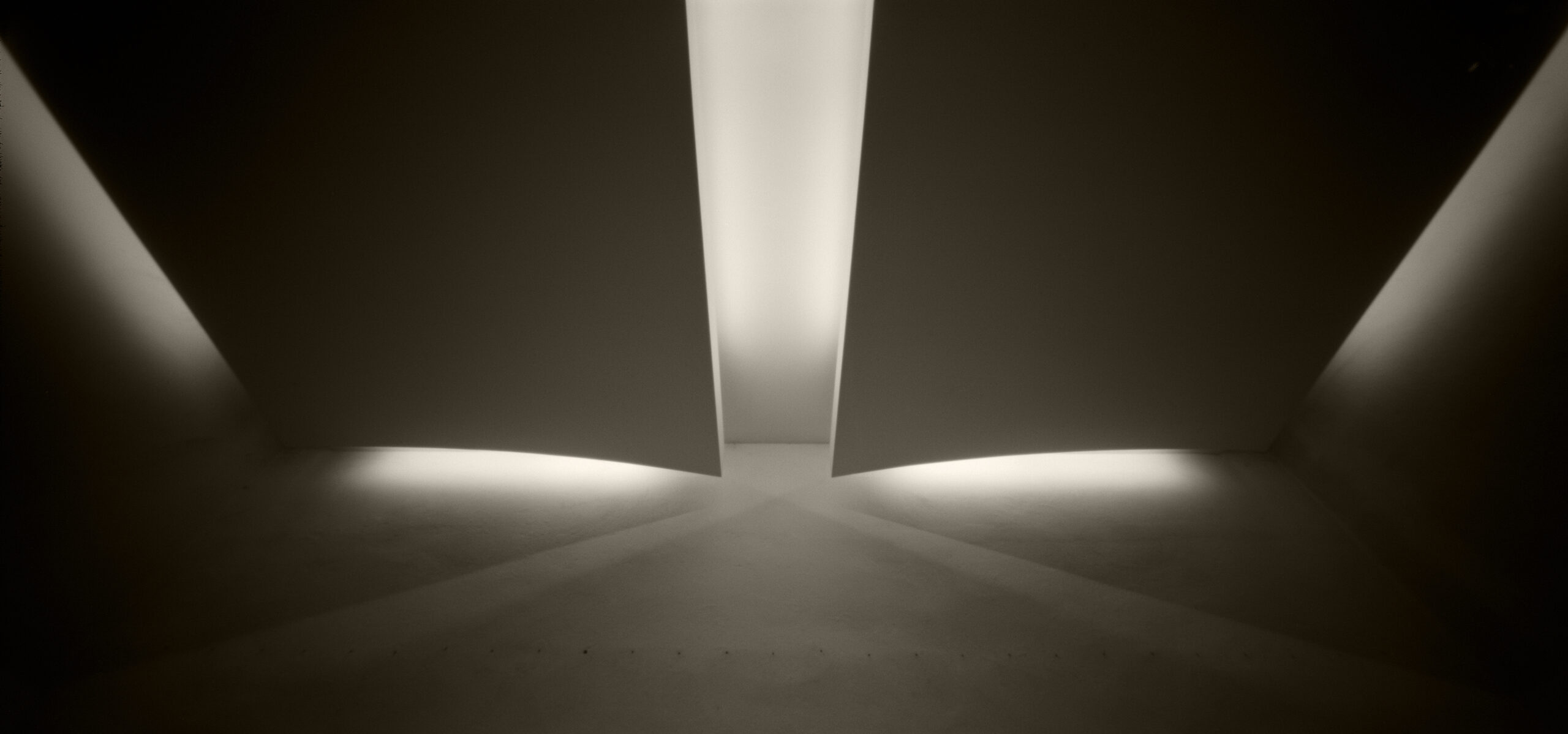
In this architectural series, Builder’s Art, he explores the ways in which light shapes space and reveals motifs that often remain unnoticed. He pays special attention to interiors, where light effects and architectural elements together create contemplative visual scenes.
About the Series- Builder’s Art
As the organ is often called the Queen of Instruments, at least for me, Architecture can be the Queen of Arts. I tend to understand buildings as walk-in sculptures. Forms and lines, light and shadows, surfaces and space make the visit to a building a discovery. Overwhelming size and small details can work together in harmony. It is the versatility of architecture that impresses me so much.
When travelling through a building, light makes the scene. It pronounces situations which otherwise would have been overlooked, it creates photographic subjects by itself, and it changes and thus creates new impressions continuously. For me, interiors are of particular interest, since such light effects play such a predominant role inside buildings. For such work, two issues are to be taken into account, particularly when using pinhole cameras.
First, and foremost, exposure times can get long, really long. That is good if people enter the scene, but they should be excluded from the image. They will if they move. Long exposures will hide them from the final image. But waiting is a prime requirement, from only seconds to minutes, sometimes 20 to 40 minutes. That is not only time-consuming but also places high demands on image composition. More often than not, questions arise during exposure about whether the positioning of the camera is definitely right.
Obviously, a tripod is my friend when working with my pinhole cameras. That is not a problem for me, but often for the responsible persons of the building. A photography permit is often mandatory, which regularly hinders or prevents spontaneous photography. Advance planning is therefore part of my photographic work.
Text by Andreas Perlick
Stairs and staircases are my stars. Repetitive steps generate pleasant forms, the often reduced space
in a staircase makes a small stage for light and forms, which I love to explore. In the Spitalkirche in
Schwabach graphic elements overflow the space. Stairs wind through the room and compete
visually with the struts of the railings. The room is somewhat reminiscent of the situations for
which M.C. Escher is so famous.
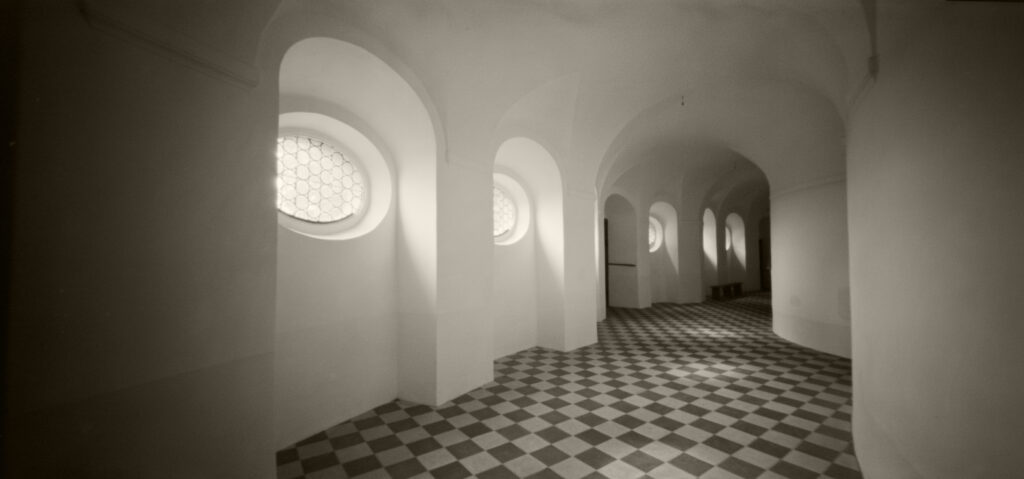
Kappl, Germany
The small Trinity chapel in Kappl is nestled in the surrounding countryside, without obvious contact
to the village. It was not the inner space of the chapel that fascinated me, even though it
obviously is an important place for pilgrims. I was captivated by the deambulatory, a circular
vestibule surrounding the actual church interior. In the outer wall, round windows let the light travel
through Romanesque arches to illuminate an impressive chequered floor. Cleaners worked in the
space during a quite long exposure, but luckily were not registered.
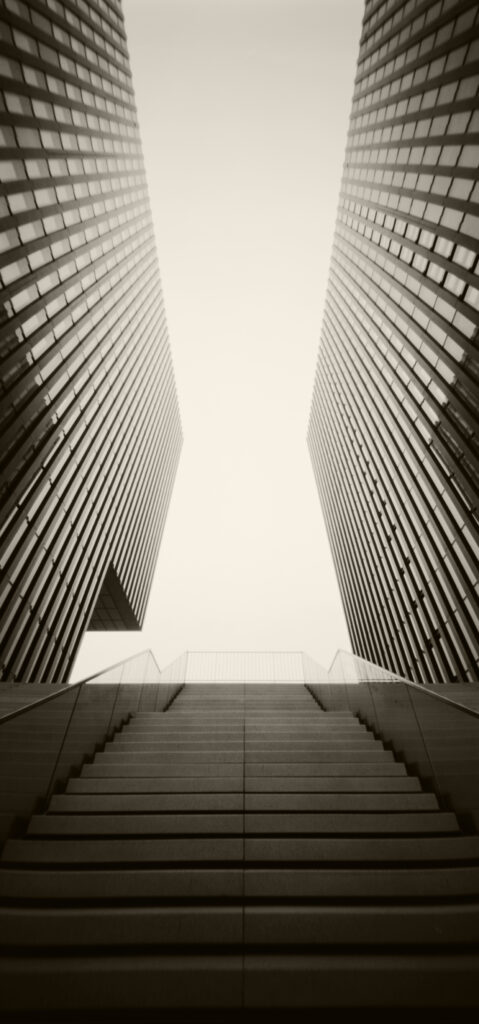
The monumental stairs in the middle of the two buildings of the Hyatt Regency in Düsseldorf are a well-known and well-used motif for photographers. But should that be a reason not to try my own interpretation? I believe not. My version concentrates on the forms and completely ignores the conversion of vertical and parallel lines. The moody morning light gave the situation a stillness not so characteristic of the location but perfect for my intention.
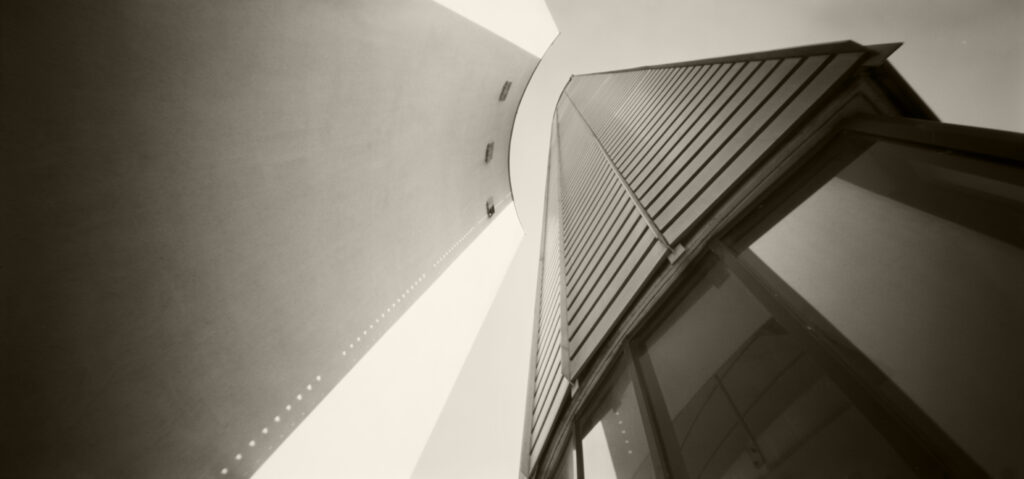
The first sight of the church near Himmelkron was not very special. A church tower, a building. The
spectacular became visible only when standing in the gap between the building and the tower, with
the eyes towards the sky. Like in an intimate chat, the two forms communicate with each other. First
I took the scene in a symmetrical way, placing the tower at the upper part of the image and the
building at the lower. Only later did it dawned to me that a dynamic composition might also work well.
Because of the prominent part light plays in this situation, I tend to visit the Himmelkron church
again and again, always when I come along.
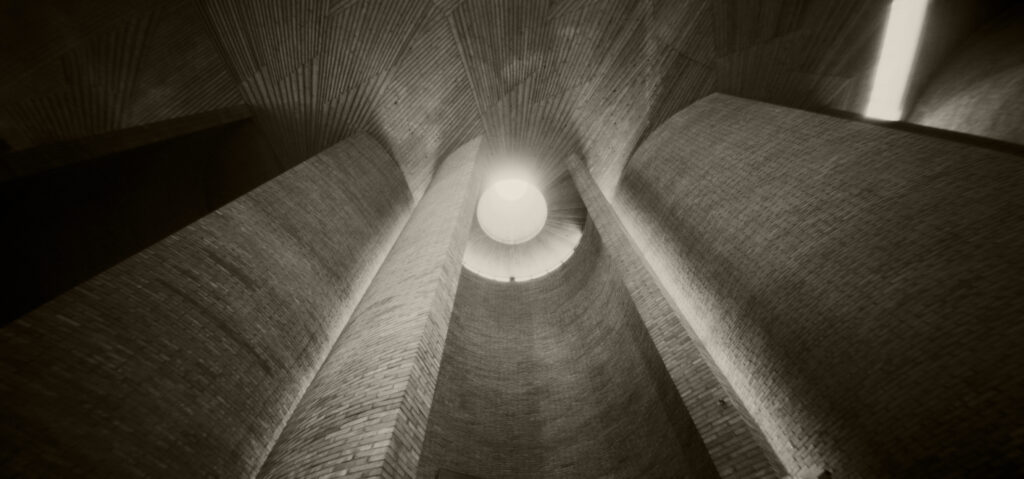
Quite a few churches are meant to be a special location for pilgrims. But I never found a place to
intensely still, so waiting for silent contemplation. I love to work photographically in churches.
Looking for situations worth capturing, discovering light flattering forms, waiting for the exposure
for minutes, thinking, meditatively – a perfect mood to find my deeper wishes. In collevalenza the
atmosphere in the church was unbelievably intense. A family in the first bench sang a song, again
and again, like a prayer. The brick-built walls, the side chapels, all cried for a pinhole photographer
capable of capturing this mood.
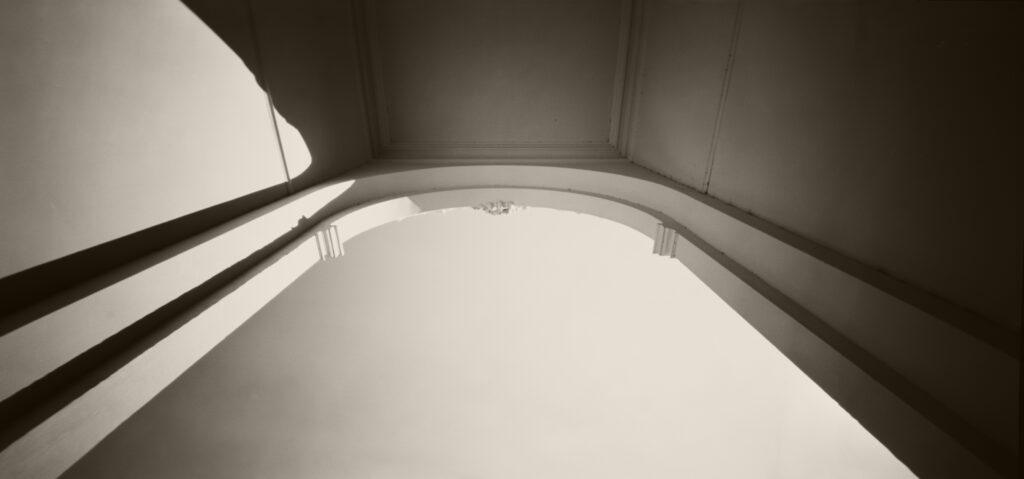
This arch seems to float – without connection to the surrounding town of Potsdam. For Germans, the
name Brandenburger Tor, meaning Brandenburg Gate, is extremely puzzling. The one and only, so
a lot of people believe, Brandenburg Gate is located in the middle of Berlin, the metropolis.
It is the symbol of the German division into a socialist and a western part. To find this beautiful
little sister was an adventure. The morning light, as so often before, prepared the stage for an out
worldly interpretation. This gate is simply formed, hovering in a grey, minimalistic space. More felt
than seen, this scene revealed its quality only in the finished image.
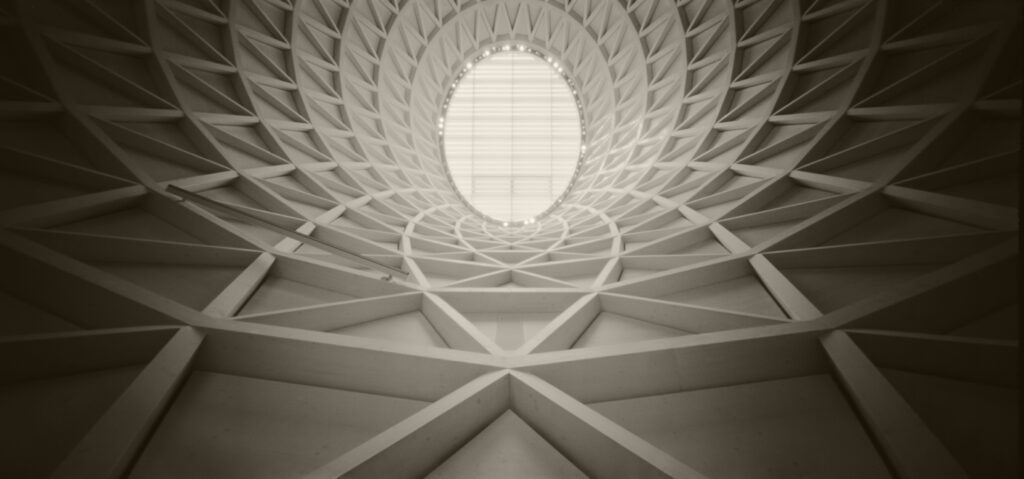
Modern architecture is a fascinating topic for photography. At the beginning of my pinhole
adventure, I thought that nature would be the goal for this type of camera. The soft character of the
image seems to be made for emotional landscape images of the pictorialist kind. Even ancient
buildings might be appropriate. Right, so, but I found out that, in contrast to my prejudice, even the
clear design of modern architecture can be depicted perfectly. In particular, the play of light with
space, form, and line worked perfectly. A special kind of modern architecture, i.e., wooden buildings
attract the interest of architects keen to experiment. Since construction details often make the
character of such buildings, they make perfect subjects for my endeavours. The church in
Holzkirchen is a perfect example. The construction elements make an almost abstract graphic
design. It was a tough job to decide how the camera should be positioned. So several studies were
made. Each one has its own merit; it seems difficult to take a wrong one.
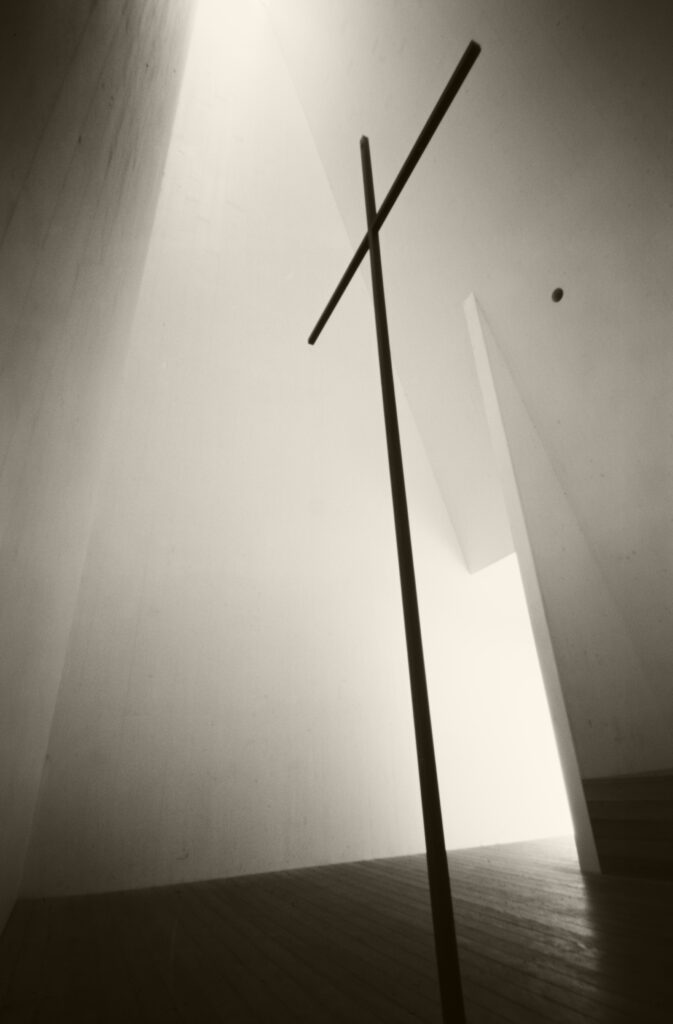
In the Swabian Danube Valley, a private foundation asked 7 architects to design individual chapels
made from wood with outstanding design. The chapels are located on a bicycle trail in order to be
experienced one after the other. Together with my wife, as always when I go on a trip, we visited
four of these chapels. Each one has a different character. The Huber Chapel is simply a tiny space
with a cross inside and a window at the top of the building. When closing the door, the light spills in
through this window and lets the inside of the building glow. Due to the limited space, it was quite a
problem to position my tripod with the camera adequately. It was more guessing than calculation.
Happily, I could get a good solution. The image lets the beholder dive into a space of light with a
cross to remember that it is a religious one.
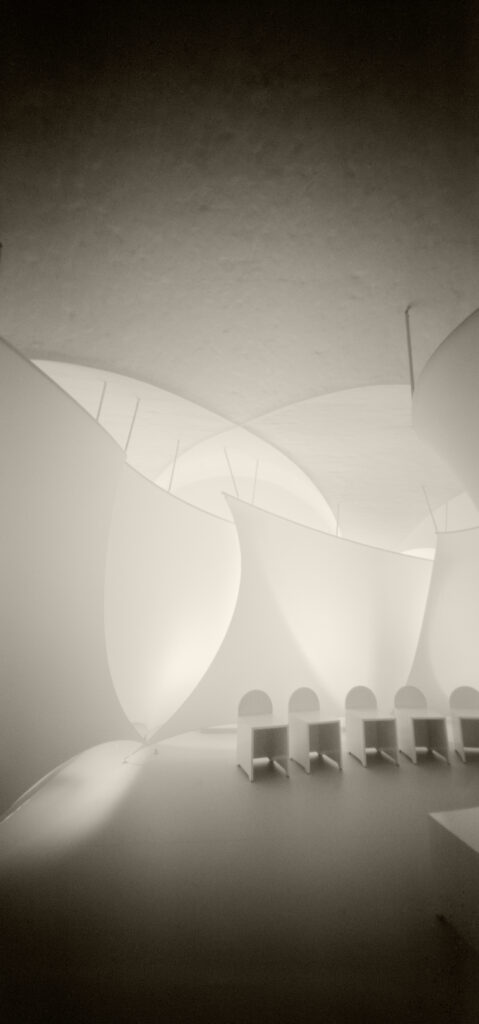
A polymer print of a friend of mine triggered my imagination. It was photographed in a cloister located in Würzburg. The nuns there constructed three new rooms to make tangible and perceptible the transition from life to death. The image that motivated me to visit this cloister was from room one. On location, I was fascinated as expected and made several exposures. But the second room was the star. It symbolises the state of waiting between the state of the living and the state of heaven. I was completely caught by the atmosphere. Between something like sails, chairs waited for the souls in transition. I feel so relieved that I was successful in transporting this magic feeling of being there into my photos.
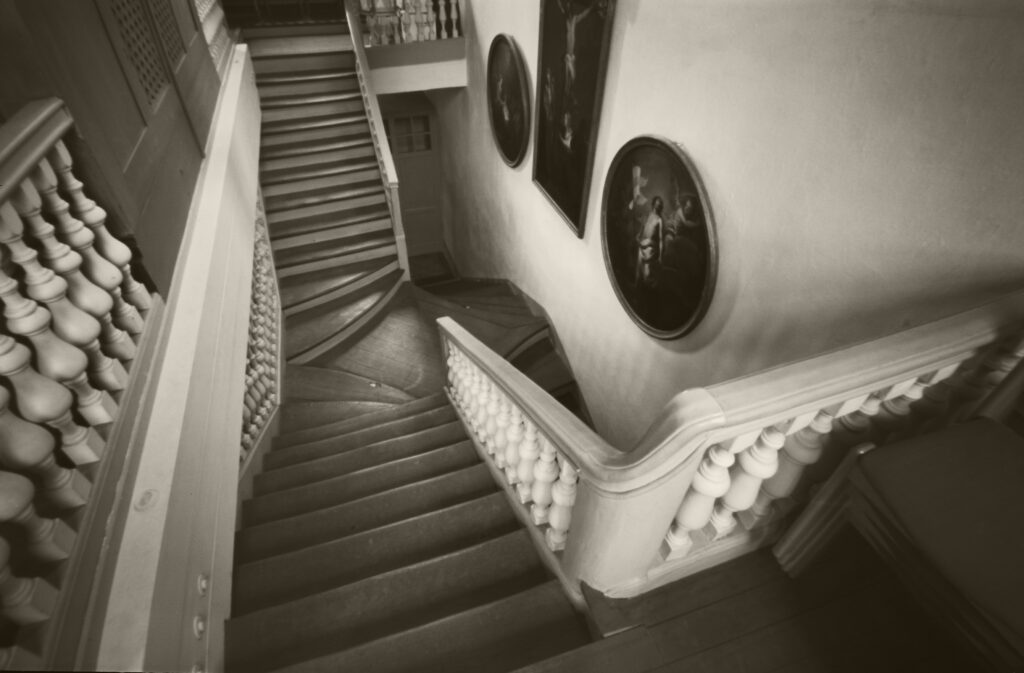
Stairs and staircases are my stars. Repetitive steps generate pleasant forms, the often reduced space in a staircase make a small stage for light and forms, which I love to explore. In the Spitalkirche in Schwabach graphic elements overflow the space. Stairs wind through the room and compete visually with the struts of the railings. The room is somewhat reminiscent of the situations for which M.C. Escher is so famous.


These images ooze a spirit of peace and tranquillity, qualities which are sadly lacking in this crazy world right now. I guess that one would expect such a feeling to emanate from ecclesiastical buildings and yet this is not automatically so. Careful positioning of the camera, expert composition and sympathetic processing after the event have combined in the hands of the master artist/photographer to draw out of these images, exactly the feeling of peace which was doubtless in the artists mind at the time of exposure. I am loathe to choose a favourite but there is some extra special magic in that wonderful image of the Transformation Room. These images are a joy to the soul.
Even though I am convinced that I work for myself and repeatedly assert this, I still notice time and again how beneficial it is to realise that there is an audience out there that likes my pictures and means well by me. Thank you, dear friend, I am delighted that you took the time to find such kind words.